Why represent the Holacracy Constitution as a reference graph
The Holacracy Constitution 5.0 runs to about 8,400 words, spread over 5 articles and some sixty sections. When I ask an AI whether a role can act in a given situation, it rereads the whole text to apply 3 to 5 of those sections. An experienced practitioner does the same work from memory, and faster, because they know the links between the rules, which the Constitution rarely writes down.
Since July 2026, I have been building another representation of the Constitution, a reference graph. Every rule, every definition and every principle becomes a node, connected to others. The relationships between them become named links, such as “takes precedence over”, “overrides” or “depends on”. A prototype now covers the whole text of the Constitution 5.0. I am writing this article to explain the thinking behind the approach before publishing its results.
Where the idea comes from
The idea came from a tool I built for Sémawé. In it, I break all of its internal reference documents and the instructions of its AI agents down into units, which I connect in a graph that shows their hierarchy. Each document declares which other documents it is subordinate to, and a script rejects any loop of subordination. When two instructions contradict each other, the agent knows which one prevails. Looking at the visualization of that graph, I realized that I could treat the Constitution the same way.
The edition of the Constitution that Sémawé develops is already organized in layers, with a Micro version, a Lite version and a full version (in French). Sémawé's clients like the shorter versions, but those versions have not attracted more of them. A layer sets how many rules an organization adopts, and a shorter text is still a text to read from start to finish. The graph follows a different logic. It slices the text rule by rule, and connects each rule to the rules that limit it or that it depends on, so that it shows only the rules that apply to a specific situation.
I then discussed it on several occasions, notably in October 2026 in Paris, at a gathering of Holacracy practitioners. One session there dealt with the governance of AI agents. An AI that helps the members of an organization running on Holacracy needs to know the rules of the game, but having it read the whole Constitution for every question is expensive, and most of the rules it reads have nothing to do with the question.
The discussion also brought out two ideas that I kept. A local map, limited to the situation, helps more than an exhaustive graph. And rules do not all carry the same weight, since some are fundamental, others secondary, and others still belong to practice and can change from one organization to another.
What the text of the Constitution leaves implicit
The Constitution 5.0 contains only 5 explicit cross-references from one section to another. The other relationships are written in prose, or not at all.
Section 1.3.2 gives an example. A Circle that delegates a Domain to one of its Roles keeps the right to define its own Policies governing that Domain, and those Policies supersede the Role's own in the event of a conflict. The precedence is stated in the text, in the middle of a paragraph, and nothing connects it to the other sections that deal with Domains.
The same section states that granting a Domain to a Role gives it no right to spend, unless explicitly specified. That sentence changes the answer to any purchasing question, and it sits 3 articles before section 4.1.3, which governs spending.
A practitioner who knows the text well rebuilds these links from memory. Someone discovering Holacracy, or an AI, has to reread the whole text and hope nothing is missed.
Chris Cowan, who worked at HolacracyOne for a long time, points out to me that this difficulty comes from the nature of Holacracy, because each of its concepts only makes sense in relation to the others. To understand a Domain, you need to know the Role that controls it, the Circle that delegates it and the Policies that govern it. That is why Holacracy remains so hard to explain to someone who has not practiced it. The graph shows that person the few rules relevant to their question at hand, with the links that give those rules their meaning.
The nodes and links of the graph
The graph distinguishes three kinds of nodes. A rule says what a Role may, must or must not do. A definition fixes the meaning of a term of the Constitution, such as Domain, Policy or unfilled Role. A principle states a broader intent, such as the distribution of authority.
Each link has a type. “Takes precedence over” connects two rules when one prevails in the event of a conflict, and a script checks that these links never form a loop. “Overrides” connects an exception to the rule it limits, with its condition. “Depends on” connects a rule to the definition or rule without which it has no meaning.
Every rule and every definition cites the paragraph of the Constitution 5.0 it derives from, with a fingerprint of that paragraph. If the source text changes, the check names the nodes to review. Principles have no such anchor, because the Constitution 5.0 does not state them. I formulate them from the declaration of principles (in French) published by Sémawé. They are an addition of this graph, which is a fork of the Constitution, meaning a derived version that evolves separately from the original text. The Constitution's license allows this fork, and these principles are not part of the official text.
For a practitioner, finding the rule that applies
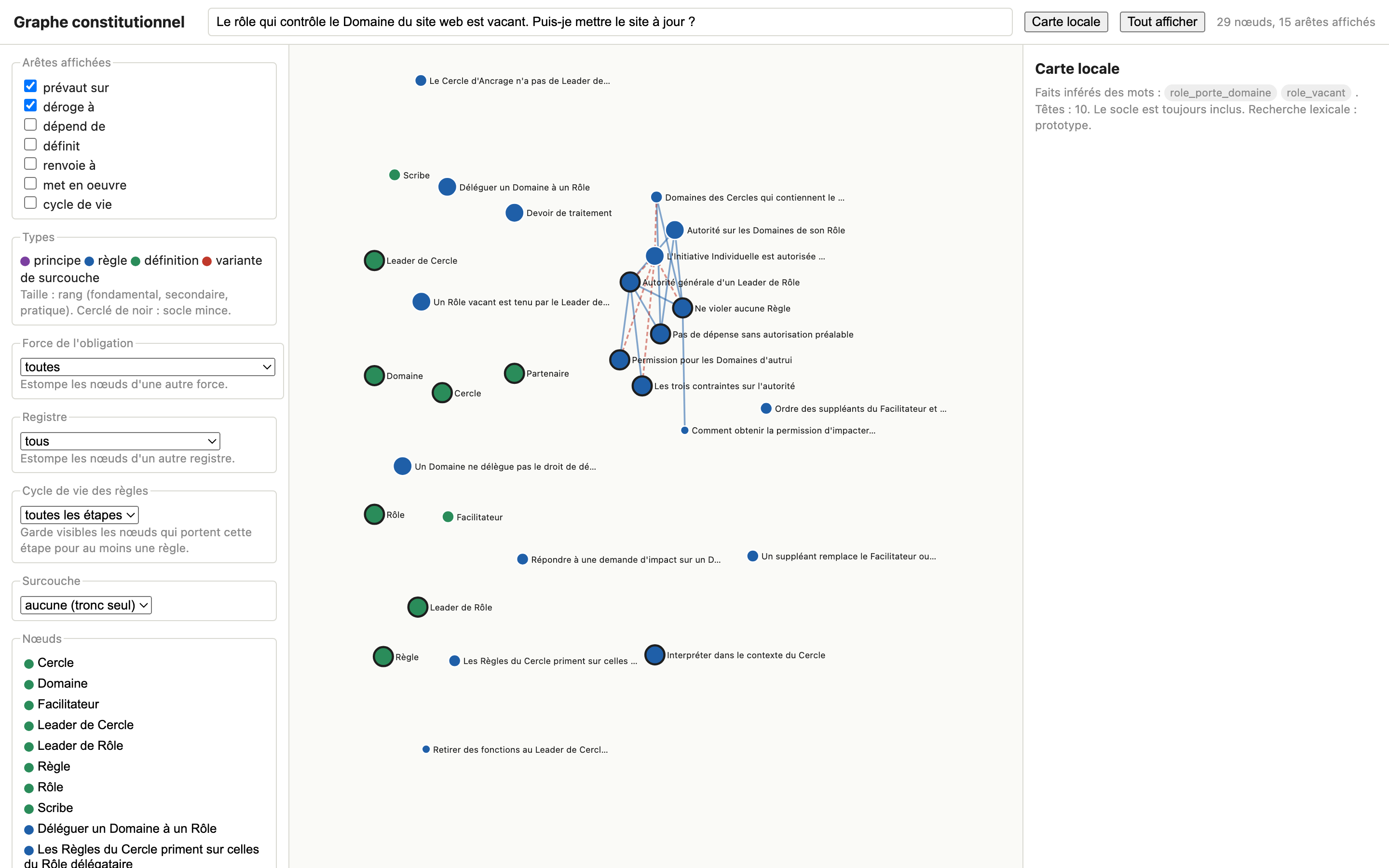
Here is a question I put to the prototype. “The role that controls the website Domain is unfilled. May I update the website?”
The answer draws on 3 sections, spread across Articles 1 and 4. Section 4.1.2 requires permission from whoever controls the Domain. Section 1.3.2 says that a Role controls a Domain on behalf of the Circle that delegated it. Section 1.4.2 says that while a Role is unfilled, each Circle Lead is considered a Role Lead of that Role. So I ask the Circle Lead for permission. Section 4.1.2 also opens another route, which is to announce my intent and wait a reasonable time for objections.
The graph presents this chain as a map of about thirty nodes, with the source section of each rule. It also lists the checks to make in the organization's governance. Is the role really unfilled? Who is the Circle Lead of this Circle? Has a Policy changed the permission process?
Seeing what takes precedence
The “takes precedence over” link orders the rules in the answer. The map shows constraints before permissions, and each exception comes with the rule it limits. For the question “I want to buy a laptop for my work, what do I need to do?”, the graph provides section 4.1.3 in full (prior authorization, written announcement, possible escalation) and the sentence in section 1.3.2 stating that a Domain does not grant the right to spend.
Seeing what the organization has adapted
The Constitution itself allows some processes to be replaced. A Policy may change the spending authorization process of section 4.1.3 “in any way”. Section 1.4.1 allows a Circle to delegate control of Role assignments to a Role other than the Circle Lead, or to a different process. An article on the Sémawé blog (in French) lists these modifiable rules.
In the graph, these rules declare a modifiable slot, with its default content. Each organization can add an overlay that replaces the content of a slot without modifying the shared core. The check rejects an overlay that would touch a rule not declared modifiable.
Sémawé's overlay gives an example. By default, the Circle Lead assigns people to Roles. At Sémawé, Policies adopted in Governance Meetings allow, among other things, each partner to assign themselves to an unfilled Role. When I ask the prototype a question about Role assignments with Sémawé's overlay, it answers with these Policies in place of the default rule, each with its reference in Sémawé's governance. An organization can thus see what it has adapted and what it applies as is.
For an AI, reading a few nodes instead of the whole text
AI is the first reader I am designing this graph for. By my estimate, the full text of the Constitution 5.0 amounts to about 12,000 tokens, the unit in which an AI counts what it reads. An AI that rereads it for every question pays that cost every time, and its attention scatters across sections unrelated to the question. On the website question, the prototype gives the AI about 2,700 words to read instead of 8,400.
Each rule also declares its triggers, that is, the governance facts it applies to (an unfilled Role, a Domain, a Policy, a spending decision), and the checks to make in the organization's governance. An AI helping a member of the organization therefore no longer has to guess where to look. Before answering, it knows which information to request from the governance tool.
The reading order depends on the question. Sometimes the rules say where to look in the governance. Sometimes a fact found in the governance, such as an unfilled Role, cannot be understood without the rules. My working assumption is that you need to know the rules of the game to understand an organization's governance. So the AI always reads first a base set of a few nodes on the hierarchy of rules, authority and interpretation.
The overlay serves the AI too. It gives the AI the rules specific to the organization it is helping, without making it read the adaptations of other organizations.
The main risk remains the missing rule. If the graph leaves out an essential rule, the AI gives a wrong answer without knowing it. To measure this risk, I have prepared 26 test questions, each with the list of rules essential to answering it, and I compare that list with the rules the graph provides.
Where the prototype stands
The prototype covers the whole Constitution 5.0, from the Preamble to Article 5 on the Governance Process. It has 178 nodes, including 14 principles, 29 definitions and 135 rules. My clients already have access to it.
The graph is a fork of the Holacracy Constitution 5.0, which HolacracyOne publishes under a Creative Commons BY-SA 4.0 license. This license allows anyone to take a text and develop it further, provided they credit the source and share the result under the same license, which the graph does. Holacracy® is a registered trademark of HolacracyOne. This graph is not an official version of the Constitution, and it commits no one but me. The official text remains the one HolacracyOne publishes.
The Constitution still exists in the form of a text. My goal is to replace the very idea of a constitution with a structural graph, a kind of cloud-like foundation that reflects the complexity of a system. So I propose that the next version of the Holacracy Constitution, 6.0, be a graph.
I will publish the next steps as the project progresses and update this article.
Frequently asked questions
Does the graph replace the text of the Holacracy Constitution?
Not today. The text published by HolacracyOne remains the official reference, and each rule in the graph points to the paragraph of the Constitution 5.0 it derives from. In the longer term, my goal is to replace the very idea of a constitution with a structural graph, and I propose that the next version of the Holacracy Constitution, 6.0, be a graph. This graph is a fork, which the Constitution's CC BY-SA license allows, and it adds principles that are not in the official text.
Can an organization adapt the graph to its own rules?
Yes, through an overlay. The Constitution itself provides that an organization may replace some of its processes with a Policy, for example spending authorization, requesting permission to impact a Domain, or Role assignments. In the graph, 23 rules declare a modifiable slot in this way. Each one specifies the process that applies by default, who has the right to replace it and what the replacement cannot touch. A Policy can, for example, change how permission is obtained, but it cannot remove the obligation to ask for it.
An organization's overlay contains two kinds of elements. Variants replace the content of a modifiable slot, and each one cites the adopted Policy that justifies it in the organization's governance records. Local rules add what the organization has decided without replacing anything, such as a Policy on expense claims. The check rejects any variant that would target a rule the Constitution does not declare modifiable.
The shared core therefore stays identical for every organization. A person or an AI who queries the graph with their organization's overlay gets the adapted rule in place of the default rule, with its reference. The organization can thus tell the rules it has adapted from those it applies as they are.
Why does an AI need a graph rather than the whole text?
Because answering an operational question, such as “Can I make this purchase?” or “Who decides when a role is unfilled?”, requires 3 to 5 sections of the Constitution out of some sixty. These sections are scattered across several articles, and nothing indicates in advance which ones. Without the graph, the AI therefore has to read 3, 4 or 5 whole articles, which is almost the whole text, for every question. The graph gives it only those sections, with their exceptions and the checks to make in the organization's governance.
Is the graph available?
Yes, my clients have access to it. The graph covers the whole text of the Constitution 5.0. I will also release the shared core freely, under the same license as the Constitution.